The Widening Wealth Gap Threatens Teachers and Students

The growing chasm between the wealthiest 1% and the rest of Americans poses a direct threat to public education. Teachers, firmly within the 99%, face unprecedented financial pressures that are driving them from the profession. This exodus has cascading effects on students, but there is something we can do… pay teachers more.
The Growing Income Inequality
America's wealth concentration has reached staggering levels. Here are some disturbing statistics that should alarm us all:
According to Federal Reserve data, the top 10% of earners control nearly two-thirds of total U.S. wealth ($8.1 million on average), while the bottom 50% own just 2.5% ($60,000 on average). Spoiler alert: Most teachers fall in the bottom 50%.
Between 1980 and 2022, wage growth for the bottom 90% reached only 36%, compared to 162% for the richest 1%.
Nationally, the average income of the top 1% is approximately $1.32 million, while the bottom 99% averages around $50,000, a ratio of 26.3 to 1.
For teachers in the bottom 50%, these numbers aren't abstract; they represent a system in which educators fall further behind economically each year as the wealth gap accelerates. The very professionals we entrust to shape the next generation are being left behind by an economy that rewards the few at the expense of the many.
Where Teachers Fall on the Income Scale
Teachers occupy a precarious position in this landscape. Let’s take a look at a few stats:
The national average public school teacher salary for 2024-25 is $72,030 (far below the top 1% threshold of approximately $1.32 million).
The national average beginning teacher salary for 2024-25 is $46,526.
Here’s the good news: $46,526 is a 4.4% increase from the previous year! This increase was the largest in the 15 years that NEA has been tracking teacher salary benchmarks. However, time for the bad news: inflation over the past 16 years has eroded salary increases, so real inflation-adjusted starting salaries are now $3,728 below salaries of teachers in 2008-2009.
The "teacher pay penalty" quantifies this disparity. This penalty is seen in the fact that in 2024, teachers earned 26.9% less than similarly educated professionals (the largest gap on record). As you can see, it is trending in the wrong direction. See figure A.
Figure A (Teacher Pay Penalty)
In 2024, teachers earned 26.9% less than comparable college graduates, illustrating the "teacher pay penalty."
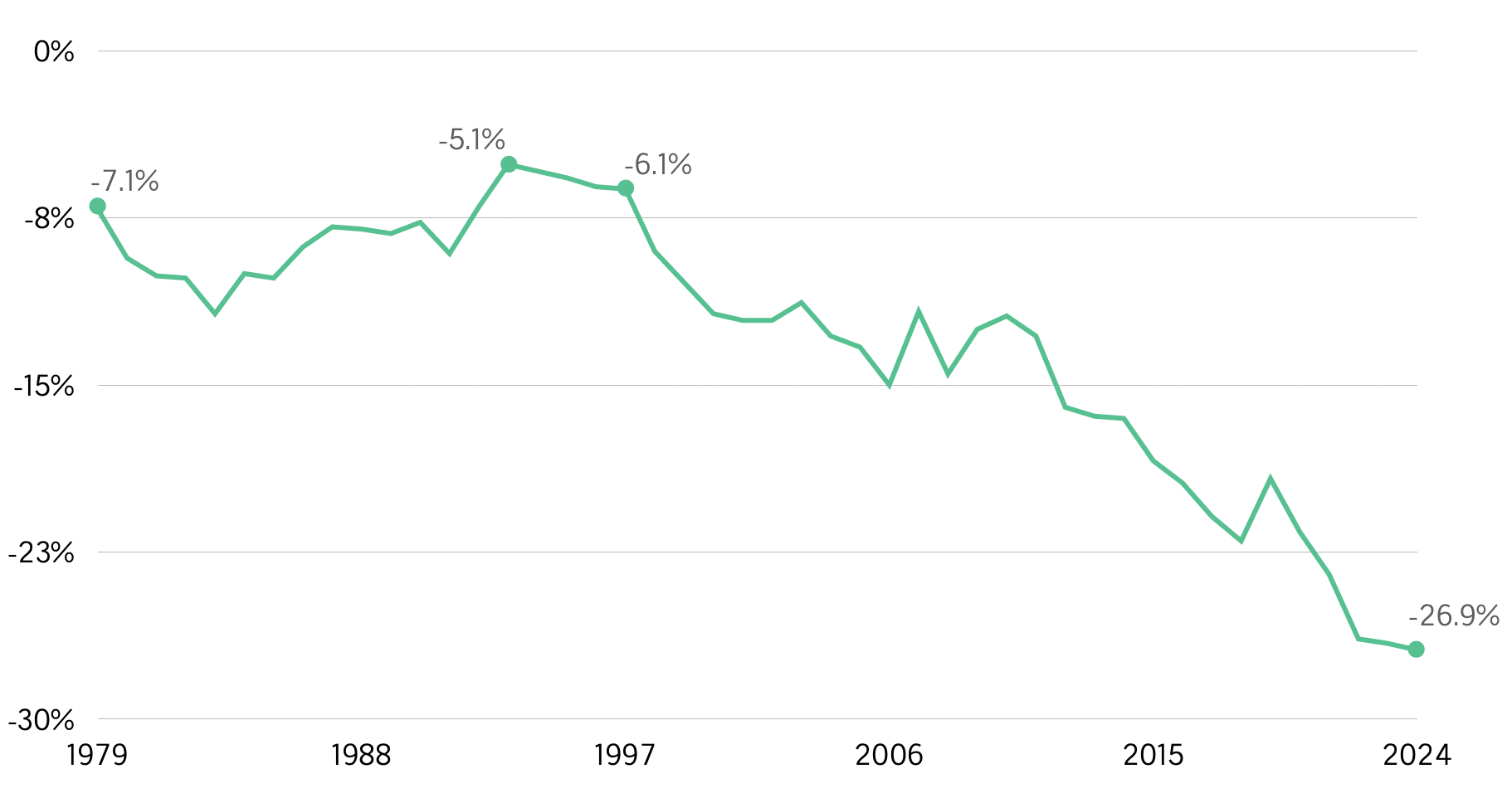
Another way to look at this data, teachers now earn just 73.1 cents per dollar that their college-educated peers earn in other professions, down from 93.9 cents in 1996.
Impact on Teachers and the Profession
These financial realities are driving teachers from classrooms at alarming rates. In 2025, approximately 1 in 8 teaching positions nationwide are either vacant or filled by teachers who are not fully certified for their assignments. According to a RAND Corporation survey of 1,419 K–12 public school teachers nationwide, 16% intended to leave by the end of the 2024-25 school year. And what is the main stress point for teachers? You guessed it, low pay.
Digging into the data, financial stress underlies their strain: 39% of teachers report that their low salaries are a major source of stress.
Another study draws a more direct link between attrition and low pay. GBAO Strategies, on behalf of the State of California’s Public Schools, surveyed more than 2,000 TK-12 public school educators. They uncovered that:
4 in 10 surveyed California educators are considering leaving education in the next few years, and 77% say financial strain is influencing their decision.
More than 1 in 3 younger educators are considering leaving, and 92% cite financial reasons.
More than half of educators know coworkers who have left the profession due to financial strain.
These stats aren’t great. And here’s the reality: as income inequality grows, it will have an even greater impact on teachers than what the current data shows. The fact of the matter is that teachers will leave the profession at even higher rates. This grave reality underscores our mission at The Educator Fund: if we want better student outcomes, we must pay our teachers more!
Let’s shift our focus to students. What impact does the growing pay inequality and inadequate teacher compensation have on students, assuming it leads to higher teacher attrition?
Adverse Effects on Students
The consequences of teacher attrition extend far beyond empty classrooms; they fundamentally undermine student learning.
Students Suffer from Teachers Leaving
Research from Stanford University found that students in grade levels with higher teacher turnover score lower in both English Language Arts and math. Critically, this effect impacts all students in a school, not just those assigned to a new teacher. When experienced educators leave, they take with them institutional knowledge, established relationships with families, and collaborative partnerships with colleagues that benefit the entire school community.
Another study found that losing a teacher during the school year equates to losing between 32 and 72 instructional days. For students already struggling academically, this setback can be devastating.
And Yes, Teachers are Leaving
So are teacher leaving their schools? Unfortunately, the answer is yes. One study found that, on average, 23% of US teachers left their schools in the 2022–23 school year, a much higher rate than during the pandemic. During the same period, 30% of rookie teachers left their schools.
Students and Schools Feel the Impact
High turnover creates a vicious cycle. When teachers leave, schools often respond by hiring inexperienced or underqualified replacements, increasing class sizes, or cutting course offerings entirely. Students lose access to veteran educators who have refined their craft over years of practice. Research consistently shows that teachers become significantly more effective as they gain experience, only for that experience to walk out the door with every departure.
The financial toll compounds the educational one. Districts spend between $9,000 and $20,000 (or more) to replace each departing teacher, diverting funds from instruction, classroom resources, and student support services. Nationally, teacher turnover costs exceed $8 billion annually. That's $8 billion not going toward smaller class sizes, updated textbooks, or mental health assistance for children.
Conclusion
The link between income inequality and student outcomes is undeniable. As wealth concentrates among the top 1%, teachers (essential architects of future generations) find themselves unable to sustain careers in their chosen profession. Their departure doesn't just leave a vacancy; it leaves students with fewer experienced mentors, less instructional continuity, and diminished educational outcomes.
When we allow teachers to earn 73 cents on the dollar compared to similarly educated professionals, we aren't just undervaluing educators; we're undervaluing the children they serve. Every teacher who leaves due to financial strain leaves dozens of students without a trusted guide. Every unfilled position represents a classroom of young people who deserve better.
The data is clear: if we want stronger student outcomes, we must invest in the people who make those outcomes possible. Teacher compensation isn't a line item; it's the foundation of educational quality. Until we close the gap between what teachers earn and what they deserve, our students will continue paying the price.
If you would like to support our efforts, please feel free to get involved. And if you really want to help drive change, donations are a great way to do so!